Energy Storage
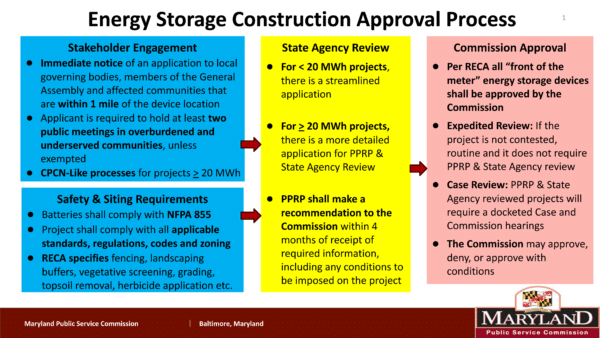
Energy Storage Construction Approval
Unless an energy storage project requires a Certificate of Convenience and Necessity (CPCN), which is required for some solar+storage projects, there are 3 pathways for front-of-the-meter energy storage device approvals:
- The Commission’s Consent Agenda (generally for smaller uncomplicated projects and waiver requests with no opposition)
- The Commission’s Administrative Agenda (the normal pathway)
- A Docketed Case (generally energy storage devices greater than or equal to 20 MWh AC)
The application for front-of-the-meter energy storage device approval for projects less than 20 MWh can be obtained from <20 MWHr application.
The application for front-of-the-meter energy storage device approval for projects greater than or equal to 20 MWh can be obtained from >= 20 MWHr application.
If the applicant has any questions regarding this process, please email Staff at psc.energystoragestaff@maryland.gov for guidance.
Renewable Energy Certainty Act
The Renewable Energy Certainty Act (Act) codified as Public Utilities Article (PUA) §7–219., Annotated Code of Maryland makes changes to various processes and procedures associated with energy storage devices, including stipulating that a person may not begin construction of a front-of-the-meter energy storage device unless the construction has been approved by the Commission. The Act was approved by the Governor on May 20, 2025, and went into effect on July 1, 2025. For more information on the Act’s requirements, please read the following document on Energy Storage provisions in the Act.
Next Generation Energy Act
The Next Generation Energy Act (NGEA), signed by the Governor on May 20, 2025, and codified as PUA § 7-1224 - § 7-1229 and § 7-216.2 Annotated Code of Maryland, prescribes a goal of soliciting 150 MW of distribution-connected front-of-the-meter energy storage. Each electric distribution company (EDC) is required to submit to the Commission plans to procure its allocation of the 150 MW target by November 1, 2025, and November 1, 2026. The Commission is required to issue an order accepting, accepting with modifications, or denying EDC procurement plans by May 1, 2026, and May 1, 2027, respectively. Additional information can be found in the Case No. 9715 docket.
Additionally, the NGEA requires the Commission to issue at least two solicitations for a cumulative 1,600 MWs of front-of-the-meter transmission-connected energy storage. The first 800 MW capacity solicitation must be issued on or before January 1, 2026, and the second 800 MW capacity solicitation must be issued on or before January 1, 2027. The Commission has retained Power Advisory LLC to assist the Commission in meeting NGEA requirements. Additional information about the Commission’s transmission-connected energy storage solicitations can be found at the Maryland Energy Storage Request for Applications website and in the Public Conference 75 (PC75) docket.
Maryland Energy Storage Program
The Energy Storage Program Act, signed by Governor Wes Moore on May 8, 2023, and codified in PUA §§ 7-216 and 7-216.1, directs the Commission to establish the Maryland Energy Storage Program (MESP) by July 1, 2025 and targets of 750 megawatts (MW) of cumulative energy storage capacity by May 31, 2028 (Phase I); 1,500 MW of cumulative energy storage capacity by May 31, 2031 (Phase II); and 3,000 MW of cumulative energy storage capacity by May 31, 2034 (Phase III). On October 2, 2023, the Commission issued Order No. 90823 establishing the Maryland Energy Storage Program Work Group (MESPWG) tasked with implementing the MESP.
Procurement targets prescribed by the NGEA will contribute to meeting MESP targets.
Case No. 9715 docket has more information on the MESP and MESPWG. If you are interested in joining the MESPWG, please contact Anna Craggs at anna@epdiusa.org.
Need Help?
The Public Service Commission is here to help. Please contact us with any questions.